

What Is Data Engineering? A Practical Guide for Businesses
September 15, 2026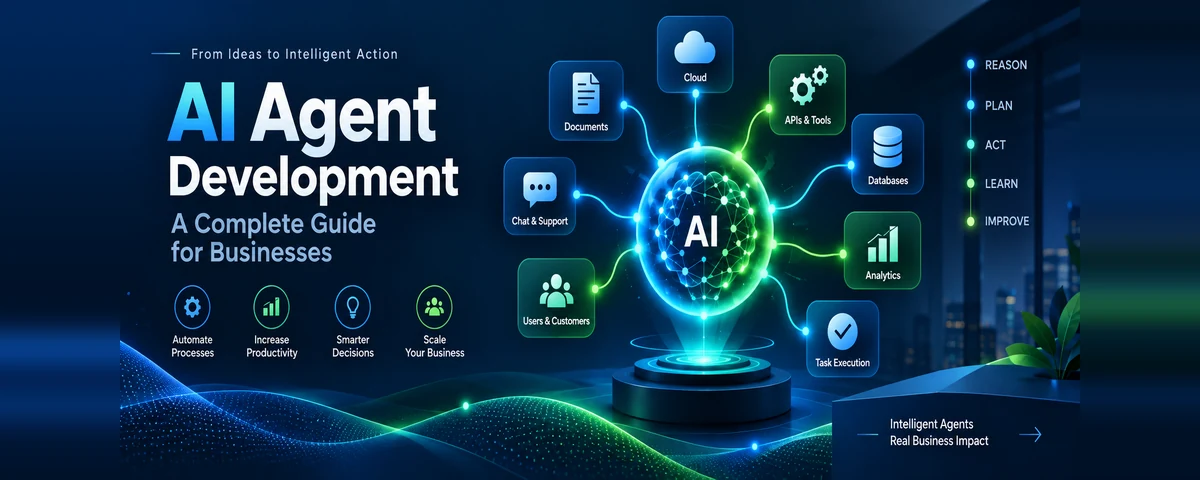
If you’ve spent any time researching AI agent development over the past year, you’ve probably noticed the term gets used loosely — sometimes for a slightly fancier chatbot, sometimes for a fully autonomous system that reads your inbox and takes action without asking first. We build these systems for clients out of Mathura, so this question comes up in almost every first call: what actually is an AI agent, and is it what your business needs? This guide walks through what an AI agent really is, what building one involves, and what to weigh honestly before you commit budget to it.
What Is an AI Agent, Really?
An AI agent is software that’s given a goal rather than a fixed script, and it figures out the steps on its own. It can look things up in a database, call an API, check your CRM, or search the web — and then decide what to do next based on what it finds, without a person clicking through each step. That’s the part that actually separates an agent from ordinary code: a normal script does exactly what it’s told, in exactly the order it’s told. An agent chooses the order, and it will sometimes choose a path you didn’t explicitly plan for.
A simple example: a support-ticket agent doesn’t just reply with a canned answer. It might check the order status in your store’s database, see that a refund was already issued, and reply accordingly — or flag the ticket for a human if the situation doesn’t match anything it’s confident about. IBM’s overview of AI agents is a solid technical starting point if you want to go deeper into how the reasoning loop actually works.
AI Agent Development: What Actually Goes Into Building One
AI agent development is not just wiring a chatbot up to a language model and calling it done. A working agent generally needs four things put together carefully: a reasoning core (usually a large language model) that decides what to do next, a set of tools it’s allowed to use (your APIs, databases, internal systems), some form of memory so it doesn’t lose context mid-task, and guardrails that stop it from doing something reckless when it’s unsure.
The guardrails are the part teams underestimate most. An agent that can issue refunds or send emails on a company’s behalf needs limits on what it can do unsupervised, logging so you can see why it made a decision, and a clear fallback to a human for anything outside its confidence range. In our experience, this is where most of the actual engineering time goes — not the first working demo, which can come together in days, but the testing and tightening that makes it safe to leave running.
AI Agents vs. Chatbots vs. Basic Automation — Where the Line Actually Is
These three get lumped together constantly, and the difference isn’t marketing spin — it’s how much the system is actually deciding on its own.
- Basic automation (think Zapier-style tools) follows fixed if-this-then-that rules. Reliable, cheap, but it breaks the moment a situation falls outside the rule.
- A chatbot answers questions using scripted flows or a language model, but it doesn’t take real action in your systems — it talks, it doesn’t do.
- An AI agent can both reason about a situation and act on it — checking a real order, updating a real record, deciding between two valid next steps based on what it finds.
A returns-processing chatbot can tell a customer your return policy. An agent can actually look up their order, check whether it qualifies, and process it — or explain exactly why it doesn’t, using the real data instead of a canned policy paragraph. That gap between talking and doing is really the whole point of AI agent development — it’s what makes the extra engineering effort worth it.
Where AI Agents Are Already Paying Off for Businesses
The use cases that tend to work well share one trait: a clear goal, and access to real data to reason over. A few patterns that come up often in AI agent development conversations with clients:
- Support triage — reading incoming tickets, checking account/order data, and either resolving the simple ones or routing the rest to the right person with useful context already attached.
- Internal knowledge lookup — an agent that can actually search across scattered docs, tickets, and past emails to answer “have we dealt with this before?” faster than a human digging through folders.
- Lead qualification — reviewing inbound inquiries against your actual criteria and prioritizing the ones worth a sales call first.
- Reconciliation work — comparing records across two systems that don’t talk to each other natively and flagging the mismatches instead of someone doing it by hand every week.
Notice none of these are “replace the whole team” pitches. The pattern that actually works is narrower and more honest than that — hand the agent one real, bounded job it can do reliably, not an open-ended mandate to run the business.
The Honest Tradeoffs Nobody Mentions
Not every process needs AI agent development, and it’s worth saying that plainly since most agencies won’t. Agents add real value when a task genuinely requires judgment across changing information. If your process is the same five steps every time with no real decisions in between, a simple automation will be cheaper, faster to build, and far more predictable — building an agent for that job is usually overkill dressed up as innovation.
Where agents are the right call, they still come with real costs to plan for: every reasoning step can involve a model call, so a poorly designed agent can get expensive fast at scale; they need monitoring after launch, not a one-time setup; and they can occasionally make a confidently wrong call, which is exactly why the guardrails from Step 2 aren’t optional. Anyone promising a “set it and forget it” agent hasn’t run one in production for long.
Choosing a Partner for Custom AI Solutions
If you’re evaluating a custom AI development company for AI agent development work specifically, a few questions tend to separate a real partner from a template shop:
- Do they want to understand your actual workflow before proposing a solution, or do they pitch the same “AI agent” pattern to every client?
- Will they build a working prototype on real (or realistic) data before asking for a full commitment?
- Are they upfront about where an agent isn’t the right fit — see the section above — or do they say yes to everything?
- What does support look like after launch? Agents drift as your business processes change, and they need occasional retuning, not a one-time handoff.
Where Inverosoft fits in
We work across web design and development, data engineering, machine learning, and custom AI agents — which usually means we’re already familiar with the systems an agent needs to plug into, not just the AI layer on top. If you’re weighing whether custom AI solutions make sense for your business, read more about our team or get in touch to talk through your specific workflow.
Frequently Asked Questions
How long does AI agent development usually take?
A narrow, single-task agent can go from first prototype to a working version in a few weeks; anything that touches multiple internal systems or needs heavier guardrails realistically takes longer. The scope of what it’s allowed to touch matters more than the complexity of the AI itself.
Do we need a huge dataset before we can start?
No — most business agents lean on your existing systems (databases, APIs, documents) rather than needing a custom-trained model from scratch. A large training dataset only becomes necessary for fairly specialized reasoning tasks, which is a smaller slice of real projects than people assume.
What does a project like this cost?
Cost is really driven by scope, not by AI agent development being inherently expensive — how many systems the agent needs to connect to, how much oversight/guardrail work is needed, and ongoing usage volume all matter more than the base technology. There isn’t an honest flat number to quote here; a short conversation about your actual workflow gets you a real estimate faster than any generic pricing page would.
Can an AI agent work with the software we already use?
Usually yes, as long as the system has some form of API or exportable data access. Older or heavily custom internal tools sometimes need a bit of extra integration work first — worth flagging early rather than discovering it mid-project.
AI agent development is still new enough that a lot of the “best practices” are being written in real time, including by the teams building them. If you’re trying to figure out whether one actually makes sense for your business, the fastest way to know is usually a plain conversation about your workflow rather than another generic sales deck — reach out and we’ll tell you honestly if it’s a fit.
