
How to Choose the Right Web Design Company
September 21, 2026
React Native vs Flutter: Which Should You Choose?
September 23, 2026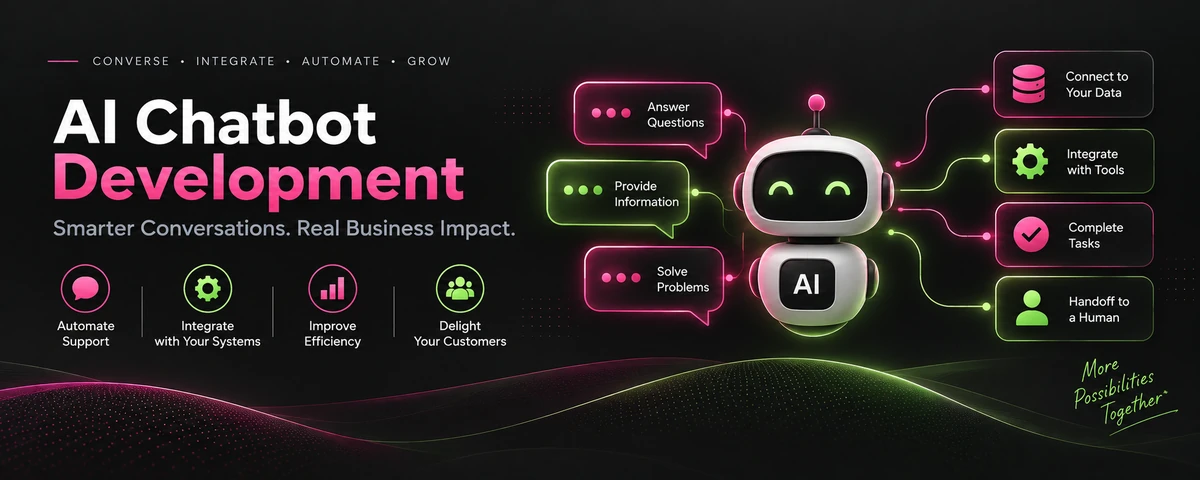
Most businesses that reach out to an AI chatbot development company have usually already tried the free version of something — a basic plugin, a template bot — and hit its ceiling within a week. That’s usually the moment the actual requirements get clearer: not “a chatbot,” but a chatbot that can look up a real order, answer a specific question correctly, and know when to hand off to a human instead of guessing. This guide covers what actually separates a good business chatbot from a frustrating one, and what to expect from a real build.
What Makes a Good Business Chatbot
The chatbots people actually tolerate — and the ones that quietly fail — usually differ on one thing: whether the bot knows the edges of what it can confidently answer. A good chatbot handles its core cases well and hands off cleanly the moment a question falls outside them. A bad one either refuses to escalate (leaving a frustrated user stuck in a loop) or escalates everything (making the bot pointless). Getting that boundary right is most of the actual engineering work, more than the conversational polish people usually focus on first.
Rule-Based, AI-Powered, or Hybrid — Choosing the Right Approach
This is usually the first real decision an AI chatbot development company should walk you through. A rule-based bot follows fixed decision trees — reliable and predictable, but brittle the moment a question doesn’t match an expected pattern. A language-model-powered bot can handle much more varied phrasing and genuinely understand intent, but needs real guardrails so it doesn’t confidently answer something it shouldn’t. Most business chatbots worth building today are hybrid: language-model understanding layered over a defined set of business rules and real data lookups, not an open-ended conversation with no boundaries. IBM’s overview of chatbots covers the broader technical landscape if you want more background on how these pieces fit together.
What an AI Chatbot Development Company Should Ask Before Building Anything
- “What are the actual questions your customers ask most often?” A chatbot built around real, common questions works; one built around a generic template doesn’t.
- “What systems does it need to check — orders, inventory, account status?” A chatbot that can’t look up real data is just a fancy FAQ page. The integration work is usually the harder, more valuable part.
- “What happens when it doesn’t know the answer?” There should be a real, tested handoff path to a human, not a dead end.
- “How will you measure whether it’s actually working?” A team with no answer here is building something they can’t improve later, since they won’t know what’s failing.
An AI chatbot development company that can’t answer these specifically, and instead talks mostly about which language model they use, is focused on the wrong part of the problem.
Where Chatbots Fall Short
A chatbot is genuinely the wrong tool once a task needs to take real multi-step action across systems rather than just answer questions or retrieve information — processing a return, updating a record, coordinating something across tools. That’s closer to what we cover in our guide to AI agent development, which is a meaningfully different (and usually more involved) kind of build. Knowing which one you actually need before starting saves real budget — a chatbot dressed up to pretend it’s an agent tends to disappoint, and an agent built for a job a simple chatbot could have handled is real overkill.
Where Inverosoft fits in
We build chatbots and full AI agents alongside web development, mobile apps, and data engineering — so we’re usually already familiar with the systems a chatbot needs to check, not just the conversational layer on top. If you’re not sure whether you need a chatbot or something more involved, read more about our team or get in touch and we’ll help you figure out which one actually fits.
Frequently Asked Questions
How long does a chatbot project usually take?
For most AI chatbot development company engagements, a focused chatbot answering a well-defined set of questions with one or two system integrations can launch in a few weeks. Scope creep — trying to cover every possible question on day one — is the most common reason timelines stretch.
Do we need a huge FAQ list to get started?
No — starting narrow with your actual most-common questions and expanding based on real usage works better than trying to anticipate everything upfront. A bot that handles ten real questions well beats one that handles a hundred poorly.
Can a chatbot connect to our existing customer support system?
Usually yes, as long as that system has some form of API access. Older or heavily custom support tools sometimes need extra integration work — worth checking early rather than assuming.
How do we know if the chatbot is actually helping?
Track how often it resolves a question without a human handoff, and separately, how often users seem frustrated or ask to speak to a person. Both numbers matter — a high resolution rate with hidden frustration usually means it’s answering confidently but wrong.
Same as with any AI vendor, our broader guide to choosing an AI development company covers questions worth asking beyond chatbots specifically. A good AI chatbot development company spends most of its effort on the boundaries — what the bot handles, what it hands off, and how you’ll know it’s working — not just the conversation itself. If you want a straight read on whether a chatbot is the right fit for your business, reach out and we’ll tell you honestly.

4 Comments
[…] what makes the extra engineering effort worth it. If a chatbot is actually all you need, our guide to AI chatbot development covers what that involves […]
[…] build AI agents, chatbots, and offer AI consulting alongside web development and data engineering — so we’re usually […]
[…] our WhatsApp marketing message examples. If what you need is a conversation and not a campaign, our AI chatbot development guide covers that side, or you can get in touch and tell us what you are trying to […]
[…] AI for the questions that do not fit, and a quick hand-over to a person when the bot is unsure. Our guide to AI chatbot development goes deeper into how the AI side is built and […]