

How to Choose the Right Mobile App Development Company
September 17, 2026
How to Choose the Right Software Development Company
September 18, 2026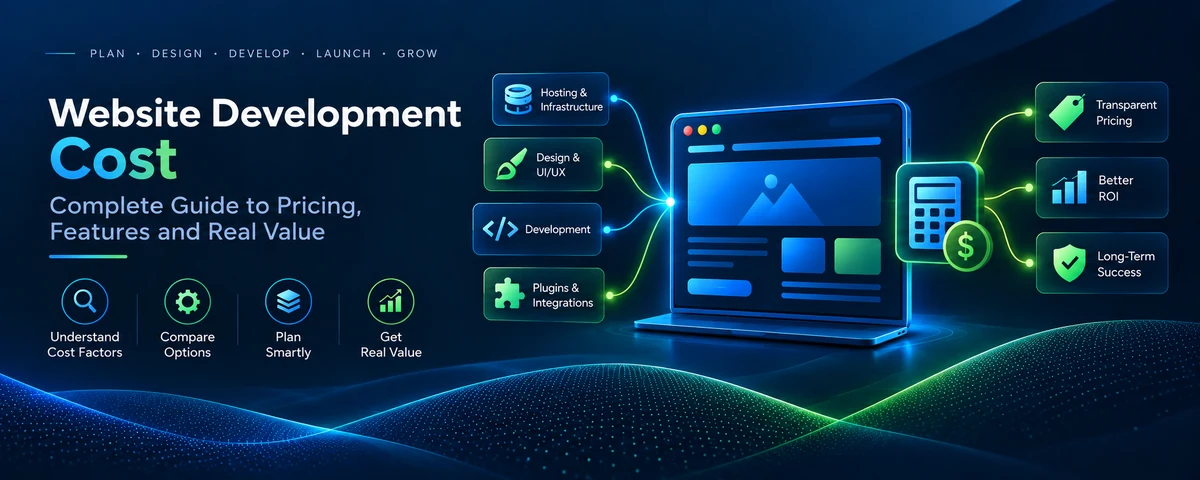
“How much does a website cost?” is one of the first questions almost every business asks, and it’s also one of the hardest to answer honestly with a single number — anyone who quotes you a flat figure before asking what you actually need is usually guessing, or padding. Website development cost genuinely varies by an order of magnitude depending on what “a website” actually means for your business. This guide breaks down realistic ranges, what actually drives the price, and the costs people tend to forget until after launch.
Why There’s No Single Answer
A five-page brochure site for a local business and a custom-built platform with user accounts, payments, and an admin dashboard are both technically “a website,” but they have almost nothing in common in terms of effort. Before any number means anything, it needs to be attached to a specific type of project — which is exactly what a good web development company should ask about before quoting, not after (our guide to choosing one covers the questions worth asking).
Website Development Cost by Type of Site
Rough, realistic ranges — actual numbers vary by region and by who you hire, but the relative gap between tiers holds up pretty consistently:
- Simple brochure/informational site (5-10 pages, no custom functionality) — the lowest tier, often built on a theme with light customization.
- Custom-designed business site (unique design, a blog, contact forms, maybe a booking or inquiry system) — meaningfully more, because it involves real design work and some custom development, not just theme configuration.
- E-commerce site (product catalog, cart, payments, inventory) — higher still, and the range within this tier is huge depending on catalog size and whether it integrates with existing inventory/accounting systems.
- Fully custom web application (user accounts, a real backend, integrations with other business systems) — this is closer to software development than “a website,” and priced accordingly.
If a quote for website development cost doesn’t map clearly to one of these tiers plus your specific extras, ask what exactly is included — vague scope is where surprise invoices come from later.
What Actually Drives the Price Up or Down
A few factors matter far more than most people expect going in: custom design versus a template (a unique design from scratch costs real designer hours a good theme doesn’t), the number of unique page templates (not total pages — ten blog posts using one template cost far less than ten uniquely designed pages), custom functionality (a booking system, a member portal, anything that isn’t “display content” is software development, not just page-building), and content readiness — a client who shows up with finished copy and images moves faster and cheaper than one who needs all of that created too. Performance and technical quality also cost real time; Google’s own web.dev resources are a good reference for the kind of technical baseline (speed, accessibility, mobile-friendliness) that a properly built site should actually meet, and meeting it isn’t free.
The Real Cost of the Cheapest Option
A rock-bottom quote usually means one of a few things: a heavily templated build with minimal customization passed off as custom work, corners cut on mobile responsiveness or performance that show up later as lost traffic, or a site built in a way that makes future changes expensive because nothing was documented or built to be extended. None of that shows up in the initial number — it shows up six months later as a rebuild. The cheapest quote isn’t always wrong, but it’s worth asking directly what’s being left out to hit that price.
Ongoing Costs People Forget to Budget For
Website development cost usually gets quoted as a one-time build number, but the build itself is rarely the whole bill. Hosting is an ongoing monthly or yearly cost that scales with traffic and site type. Domain renewal is small but easy to forget until it lapses at the worst time. Security updates and plugin/software maintenance matter — an unmaintained site is a real security risk, not just a cosmetic issue. And most businesses underestimate how often they’ll want small content or design changes after launch — budgeting for at least occasional maintenance hours avoids the awkward situation of a site that’s technically live but nobody can safely touch.
Where Inverosoft fits in
We build websites alongside mobile apps, data engineering, and AI work, which means a site we build is usually set up to actually connect to the rest of your business systems from day one — not bolted together later. If you want a realistic number instead of a guess, tell us what you’re actually trying to build — read more about our team or get in touch for a real quote. If you are weighing what a complete build involves, our guide to what a full-service website development company covers explains the parts beyond the visible design.
Frequently Asked Questions
Is a cheaper website ever the right call?
Yes — if your actual need is simple (a basic informational presence, no custom functionality) and your budget is genuinely limited, a lighter-weight build is the correct choice, not a compromise. The problem isn’t cheap options, it’s mismatched expectations about what a cheap option actually includes.
Should I pay for a website upfront or in installments?
Most legitimate web development companies split payment across milestones — a deposit to start, a payment at design approval, a final payment at launch. Being asked for 100% upfront with no milestones is worth questioning.
Does website development cost include content writing?
Not usually, unless explicitly quoted as part of the website development cost — copywriting, photography, and product descriptions are often a separate line item. Ask specifically, since it’s one of the most common gaps between a quote and the final invoice.
How long does a typical website project take?
A straightforward brochure site can realistically launch in 3-4 weeks. Custom-designed sites or anything with real functionality usually take longer — content readiness on the client’s side is often the actual bottleneck, more than the development work itself.
Website development cost is really a function of scope, not a fixed number anyone can quote honestly without knowing what you’re building. If you want a straight answer instead of a guess, reach out and describe what you actually need — we’ll tell you a realistic range, not just the lowest number we think will win the job.

3 Comments
[…] questions from this guide — and if you want a realistic number to compare quotes against, our website cost breakdown is a good starting point. Otherwise, read more about our team or get in […]
[…] you need a refresh, a redesign, or a rebuild. It helps to know roughly what to budget first — our website cost breakdown is a good place to start, and our guide to responsive web development covers the mobile side of the […]
[…] options, use the questions above on us too. You can see a fuller breakdown of costs in our website development cost guide, learn how to compare vendors in our web design company guide, or get in touch to talk about your […]