

What Is Data Engineering? A Practical Guide for Businesses
September 15, 2026
How Much Does a Website Really Cost? A Practical Breakdown
September 17, 2026
Search “mobile app development company” and you’ll get thousands of results that all claim to be the best one. That’s not actually useful when you’re the one trying to hand over a real budget and a real idea. Most of the advice out there is generic (“check their portfolio,” “read reviews”) without saying what you’re actually looking for when you do those things. This guide is the more specific version — what to actually ask, what a good answer sounds like, and what should make you keep looking.
Start With What You’re Actually Building
Before evaluating any vendor, get honest with yourself about scope, because that changes who you should even be talking to. A simple booking app for one local business needs a very different partner than a marketplace app with payments, real-time chat, and multiple user roles. A shop that’s great at the first will often either turn down the second or quietly struggle through it. Write down, even roughly, what the app needs to actually do — this single step filters out more bad-fit vendors than any review site will.
Questions to Ask Every Mobile App Development Company
A handful of direct questions tend to separate a real team from a reseller or a template shop fast:
- “Who’s actually writing the code — you, or a subcontractor?” Plenty of agencies sell the project and outsource the build with no oversight. Not automatically bad, but you deserve to know.
- “What happens after launch?” Apps aren’t done at launch — OS updates break things, app store policies change, users report bugs. A real answer names a support/maintenance plan, not just “we’ll be around.”
- “Can I talk to the actual developer, not just sales?” A company confident in its work will let you. One that stalls on this is usually protecting something.
- “What was the hardest technical problem on your last project, and how did you solve it?” This is the single best question in the list — a generic non-answer here tells you more than a polished portfolio ever will.
Red Flags Worth Walking Away From
When you’re comparing more than one mobile app development company, a few patterns are worth treating as genuine warning signs, not just minor annoyances: a quote given before they’ve asked a single real question about your app, a portfolio full of screenshots with no working links or app store listings to check, pressure to sign quickly because “the price goes up next week,” and a total unwillingness to put timeline or scope in writing. None of these alone is fatal, but two or more together is a pattern worth taking seriously.
Portfolio Review: What to Actually Look For
Don’t just look at screenshots — install the actual apps if they’re live, and use them. Screenshots hide slow load times, awkward navigation, and crashes; a live app doesn’t. Check whether the apps follow real platform conventions rather than looking like a generic template reskinned five times — Apple’s own Human Interface Guidelines are a useful reference if you want to spot the difference between an app that respects iOS conventions and one that clearly doesn’t. Also worth asking directly: is this the company’s own work, or a case study borrowed from a subcontractor’s project? It happens more than you’d expect.
Native, Cross-Platform, or Hybrid — Does the Company Have a Real Opinion?
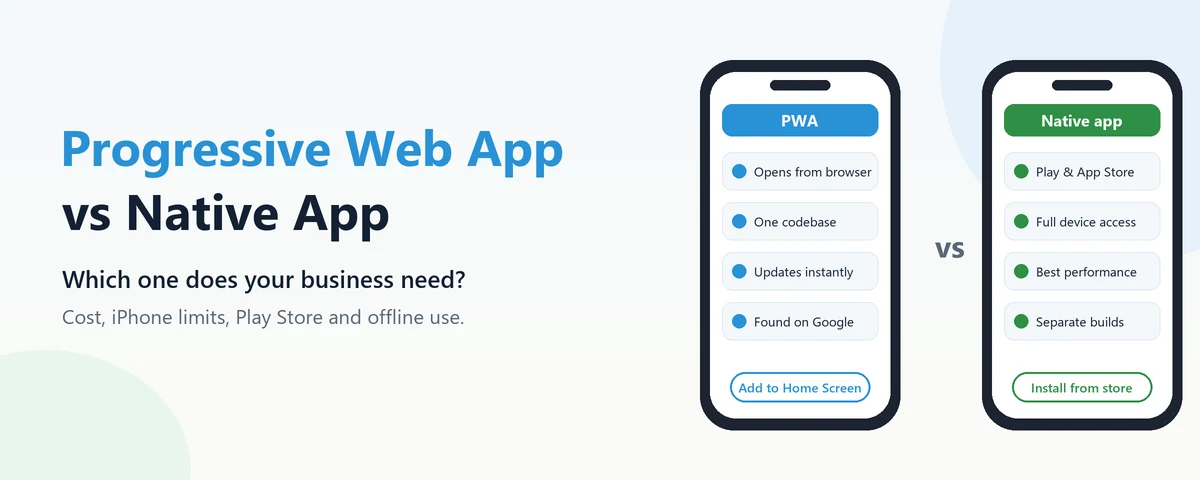
A mobile app development company that immediately pushes one approach (usually whichever they happen to know) without asking about your actual requirements is a mild red flag. Native development (separate iOS and Android codebases) tends to win for performance-heavy or platform-specific apps; cross-platform tools like React Native or Flutter tend to win for faster, cheaper builds that still need to feel native-ish; a straight web-wrapped hybrid app is usually the cheapest and weakest option, fine for something simple, a poor fit for anything performance-sensitive. A team worth hiring can explain this tradeoff in plain language specific to your app, not recite it generically — see our mobile app development cost breakdown for how much this choice actually affects the final number.
The Honest Tradeoffs Nobody Mentions
The cheapest quote is rarely the cheapest outcome. A low bid usually means either less experienced developers, corners cut on testing, or a plan to make up margin on “extra” work that was actually always necessary and just never got scoped in. That doesn’t mean the most expensive option is automatically the right one either — plenty of overpriced agencies aren’t actually better, just better at selling. The realistic goal isn’t finding the cheapest or the most impressive-sounding team; it’s finding one whose past work and answers to the questions above actually match the size and seriousness of your project.
Where Inverosoft fits in
We build mobile apps alongside web development, data engineering, and AI work — which in practice means an app we build usually needs to talk to a real backend, a real database, or a real API from day one, not as an afterthought. If you’re evaluating app development company options right now, feel free to ask us the same hard questions from this guide — read more about our team or get in touch to talk through your actual project.
Frequently Asked Questions
Should I hire a freelancer instead of a company?
A skilled freelancer can be a great fit for a small, simple app and a tight budget. The tradeoff is redundancy — if they’re unavailable or move on, there’s no team behind them to pick up the work. A company costs more but usually has that coverage built in.
How important is it that the company is local?
Less than it used to be. Time zone overlap for calls matters more than physical location for most projects — a strong remote team that’s responsive and communicates clearly usually beats a local team that’s harder to reach.
Do I need a detailed spec document before reaching out?
No, but a rough one helps you get more accurate quotes and filters out companies that just want a vague brief they can quote high on. Even a page of bullet points on what the app needs to do is enough to start real conversations.
What’s a reasonable timeline for a first version?
A focused, well-scoped app can realistically launch in 8-12 weeks. Longer timelines usually mean either a genuinely complex app or scope that hasn’t been narrowed down yet — worth asking which one it is if a quote from a mobile app development company comes back much longer than that.
Choosing a mobile app development company is less about finding the “best” one in the abstract and more about finding the one whose honest answers to specific questions actually match what you’re building. If you’d rather skip the research and just ask someone directly, reach out — we’ll give you straight answers, including if we’re not the right fit.

3 Comments
[…] does affect mobile app development cost either way. We cover this tradeoff in more depth in our guide to choosing a mobile app development company, including the questions worth asking about which approach a company actually recommends and […]
[…] well-supported — it’s picking a team with weak engineering discipline in either one. Our guide to choosing a mobile app development company covers what actually matters more than the framework […]
[…] actually cost to build well, our mobile app development cost guide is a good place to start, and our guide to choosing a development company covers what to look for in a team. Read more about our team or get in […]