

Landing Page Design: What Turns Visitors into Enquiries
October 21, 2026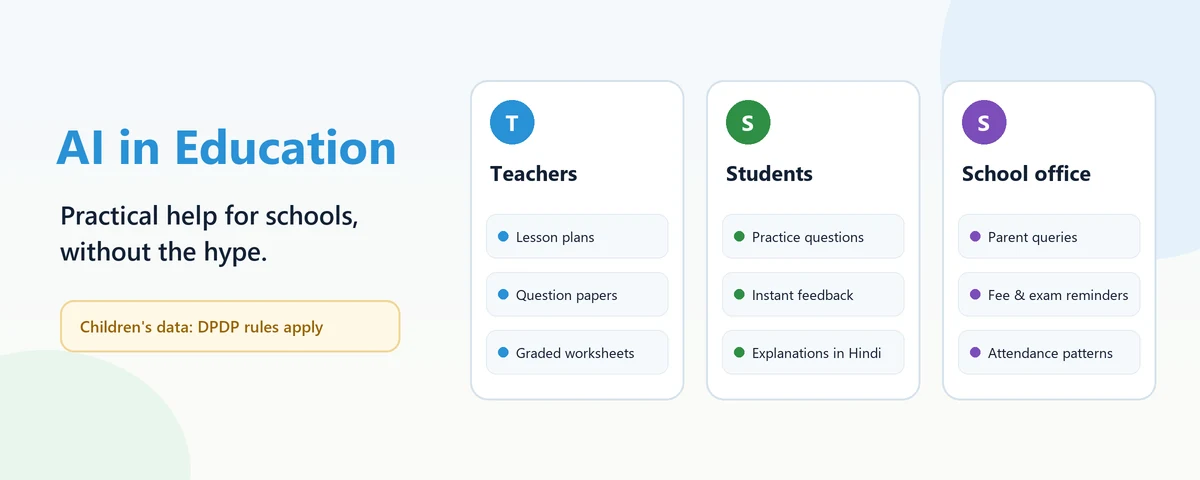
Most conversations about AI in education start in the wrong place, with robots replacing teachers or students cheating with chatbots. For a school principal or a coaching institute owner in India, the practical questions are smaller and more useful: which jobs can AI take off teachers’ desks, where does it help students learn, what will parents worry about, and what does the law now say about children’s data. This guide answers those questions without the hype.
Where AI in Education Helps Today
The useful applications fall into three groups, and they are not equally mature.
- Teachers’ preparation work. Drafting lesson plans, creating question papers at different difficulty levels, turning one worksheet into easier and harder versions for mixed-ability classes, and writing first drafts of report card remarks. This is where AI saves the most time today, as long as a teacher checks every output.
- Student practice. Extra practice questions with instant feedback, explanations of a concept in simpler words or in Hindi, and help with English writing. Useful, but only when the school sets clear rules about what is practice and what is assessed work.
- School administration. Answering repeated parent questions, sending fee and exam reminders, summarising attendance patterns, and building timetables. This is the least glamorous area and often the fastest to show results.
AI in Teaching: What Works in a Real Classroom
Teachers who get real value from AI in teaching tend to treat it as an assistant that drafts, never as an authority that decides. A science teacher might ask for ten questions on photosynthesis, keep six, rewrite two and discard two that are subtly wrong. An English teacher might generate three versions of a reading passage for different reading levels. The time saved is real, and so is the need to read everything before it reaches students.
Where it goes badly is when AI is used to grade work or judge students without a teacher reviewing the result, or when the school buys a tool before deciding what problem it should solve. Start from a task teachers already find tedious, not from a product demo.
The Administrative Side Most Schools Overlook
A school office spends a surprising share of every day answering the same questions: when is the fee due, is tomorrow a holiday, when is the PTM, what is the admission process. A large part of artificial intelligence in education is not in the classroom at all but in handling this communication. A chatbot on the school’s WhatsApp number can answer routine questions at any hour, and reminders can go out automatically to the right class instead of being typed one by one. Our guide to WhatsApp chatbots explains how that works and what it costs, and our workflow automation guide covers the wider idea.
Children’s Data: What Indian Schools Need to Know
Any use of AI in education that touches student information brings data protection into the picture. India’s Digital Personal Data Protection Act, 2023 treats everyone under 18 as a child and generally requires verifiable consent from a parent before a child’s personal data is processed. The rules under the Act were notified in November 2025, with most obligations, including the parental consent requirement, taking effect in May 2027. Educational institutions have a partial exemption for certain defined purposes, but it does not cover everything a school or its software vendors might do with student data.
The practical advice is straightforward. Know which tools hold student data and where it is stored, avoid pasting students’ names, marks or health details into public AI chatbots, read vendors’ terms on whether your data is used to train their models, and take legal advice on your own situation before 2027. We are a technology company, not lawyers, and this section is a summary, not legal guidance.
The Risks of AI in Education Worth Taking Seriously
- Confident mistakes. AI tools can produce wrong facts and wrong answers in fluent language. A wrong answer key is worse than no answer key.
- Assessment and honesty. Homework that AI can complete in seconds no longer measures what it used to. Schools need to decide which work happens in class, which is open-book, and how AI use should be acknowledged.
- Age. UNESCO’s guidance on generative AI in education recommends a minimum age of 13 for using generative AI tools in the classroom, and many tools set age limits in their own terms.
- Uneven access. If AI-supported practice depends on a phone and data at home, students without them fall further behind.
A Practical Way to Start with AI in Education
- Write a one-page policy. Which tools staff may use, what student data must never go into them, and how students may use AI in their work.
- Pick one problem. Question paper preparation, parent queries or fee reminders are good candidates because the results are easy to measure.
- Run a short pilot with willing teachers. A month with three enthusiastic teachers teaches you more than a school-wide launch.
- Measure the time saved and the errors found. Keep what works, drop what does not, and only then think about paid tools or custom software.
One honest caveat: AI will not fix a shortage of teachers or a weak curriculum. It can give good teachers back some of their time. What they do with that time still decides the results.
Where Inverosoft fits in
We build AI and automation tools for organisations, and we designed our WhatsApp bulk messaging software with schools in mind, for fee reminders, exam notices and parent updates. If you are weighing a larger AI project, our AI consulting guide explains how to scope one sensibly. To talk about your school’s needs, get in touch.
Frequently Asked Questions
Will AI replace teachers?
No. AI can draft, summarise and answer routine questions, but teaching depends on judgement, relationships and knowing each student, which software does not have.
Is it safe for students to use AI chatbots?
It depends on age, the tool and supervision. Older students can use AI well with clear rules, while younger children should use it only through tools and activities chosen and supervised by teachers.
How much does AI in education cost a school?
Starting can cost very little, since many teachers begin with existing general tools under a clear policy. Costs rise with paid platforms, custom software and integration with the school’s systems, so begin with a pilot before committing.
Does the DPDP Act stop schools from using AI?
No. It sets rules for how children’s personal data is collected and used, including parental consent in many cases. Schools can use AI, but should check what student data each tool receives and how it is handled.
AI in education is less about futuristic classrooms and more about practical help with preparation, practice and communication, handled with care for students’ data. Start small, measure honestly, and grow from what works. If you would like help planning that first step, reach out.


