

React Native vs Flutter: Which Should You Choose?
September 23, 2026
Why Responsive Web Design Matters More Than Ever
September 24, 2026
“Data warehouse” gets thrown around as if everyone already knows what it means, and then quietly misused half the time. Businesses often reach out for data warehouse services after realizing their existing database — the one running their app or website — is starting to choke every time someone runs a heavy report against it. That’s usually the real signal, more than any specific data volume threshold. This guide covers what a data warehouse actually is, how it differs from what you’re probably already running, and when it’s genuinely worth the investment.
What a Data Warehouse Actually Is
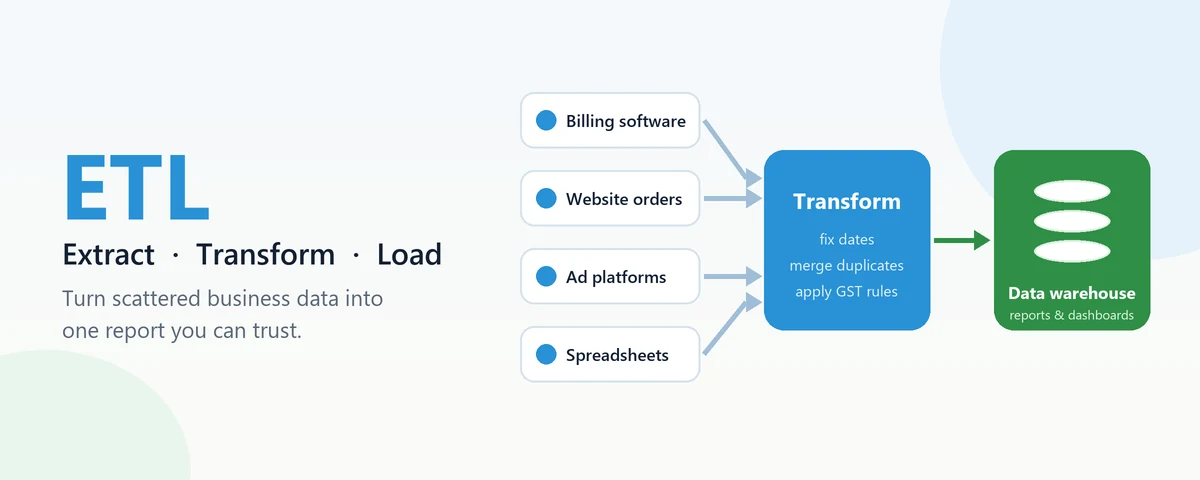
A regular application database is built for fast, small, frequent operations — adding one order, updating one customer record. A data warehouse is built for the opposite: scanning huge amounts of historical data at once to answer a broad question, like “what were our sales trends by region over the last two years.” Running that kind of heavy analytical query directly against your live application database is exactly what slows everything else down — a warehouse exists specifically to take that load somewhere else, structured for exactly this kind of work.
Data Warehouse vs. Data Lake — A Distinction Worth Knowing
These get confused constantly. A data warehouse stores structured, cleaned, already-organized data, ready for reporting and analysis. A data lake stores raw data in whatever form it originally came in — messier, more flexible, and usually a step earlier in the pipeline before it gets cleaned and loaded into a warehouse. Most businesses starting out need a warehouse, not a lake; a lake tends to become relevant at a scale and complexity most growing businesses haven’t reached yet.
Signs Your Business Needs Data Warehouse Services
- Reports are slowing down your actual application — a dashboard query visibly affecting site or app performance for real customers is a clear signal.
- You’re combining data from multiple sources by hand — manually merging exports from your CRM, your store, and a spreadsheet every week is exactly the kind of work a warehouse (paired with a pipeline) automates.
- Historical analysis is genuinely painful — if “what did sales look like a year ago compared to now” takes someone a full day to answer, that’s a real cost, repeated every time someone asks.
If none of these sound familiar yet, data warehouse services are probably premature for your business right now — see the tradeoffs section below before committing budget.
Popular Data Warehouse Platforms
The three most common choices today are Google BigQuery, Snowflake, and Amazon Redshift — all cloud-based, all genuinely solid options, with the “right” one depending more on which cloud ecosystem you’re already using than any dramatic feature gap between them. Google’s own BigQuery documentation is a reasonable place to see what a modern cloud warehouse actually looks like technically, even if you end up choosing a different platform. All three charge based on usage rather than a large upfront license, which is part of why cloud warehousing has become the default over older, self-hosted approaches.
The Honest Tradeoffs Nobody Mentions
A warehouse without a real pipeline feeding it clean data isn’t actually solving anything — it just moves the mess somewhere else. The pipeline work (covered in our broader data engineering guide) is usually the harder, more important half of the project, not the warehouse platform itself. Cloud warehouse costs are also usage-based, which means a badly written, inefficient query can genuinely cost real money at scale — query design matters more with a warehouse than with the simpler databases most businesses are used to.
Where Inverosoft fits in
We build data warehouses alongside the pipelines that feed them, plus web development, mobile apps, and AI — so the warehouse we set up is designed around where your data actually comes from, not treated as a standalone piece. If you’re not sure whether your business needs data warehouse services yet, read more about our team or get in touch and we’ll give you an honest read on where you actually stand.
Frequently Asked Questions
Can I just use my existing database as a warehouse?
For a while, sometimes — but you’ll eventually hit the performance wall this guide opened with. Separating analytical workloads from your live application database is the whole point, and delaying it usually just delays the inevitable at growing cost to your app’s performance in the meantime.
How much do data warehouse services typically cost?
It depends heavily on data volume and query patterns, since cloud warehouses bill by usage rather than a flat fee. A small business with modest reporting needs pays meaningfully less than one running constant, heavy analytical queries — there’s no fixed number without knowing your actual usage.
Do I need a data engineer on staff to maintain one?
Not necessarily full-time, but someone needs to own monitoring the pipelines feeding it and reviewing query performance periodically. Many businesses handle this through an ongoing arrangement with a data engineering company rather than a full in-house hire.
Is a data warehouse only useful for large companies?
No — the trigger is really about reporting pain and data-source sprawl, not company size. A growing small business juggling several disconnected tools can hit the same wall a much larger company does, just sooner relative to its size.
A data warehouse is genuinely one of the highest-leverage pieces of infrastructure a growing business can invest in, but only once the real triggers above actually show up — not before. If you want an honest read on whether you’re there yet, reach out and we’ll walk through it with you.

2 Comments
[…] removing duplicates, matching records across systems), loads it somewhere usable — often a data warehouse — and then runs on a schedule so it stays current without someone doing it by hand. The transform […]
[…] belongs in ready-made tools and how much needs custom code. If ETL is new to your business, our guide to data warehouses explains where the data ends up, and our database migration guide covers moving older systems […]