

AI Consulting Services: How They Actually Help Businesses
September 19, 2026
How Much Does Mobile App Development Cost? A Realistic Breakdown
September 21, 2026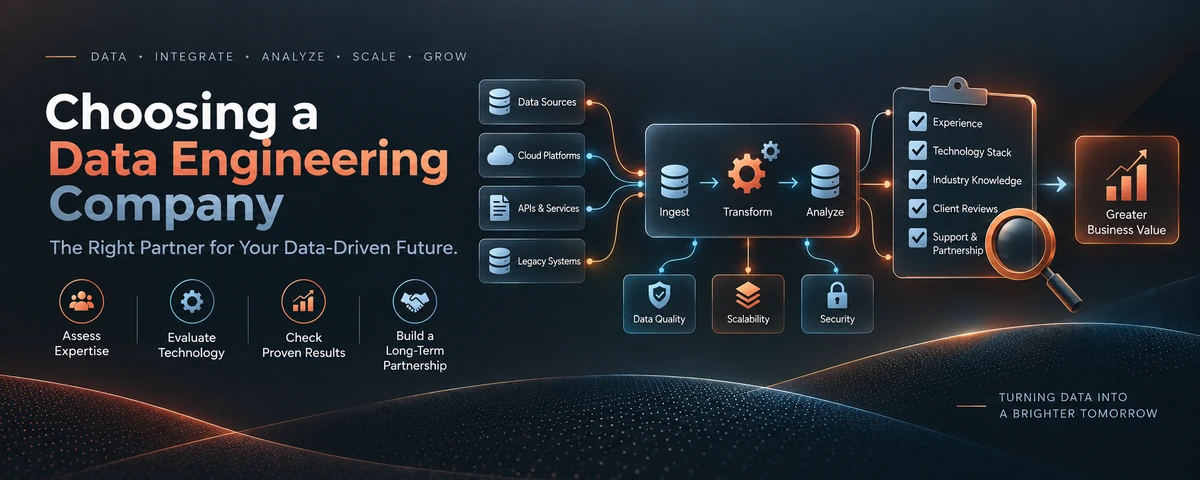
Picking a data engineering company is a different exercise from picking most other software vendors, mostly because the mistakes are quieter. A bad website redesign is obvious the day it launches. A bad pipeline can run for months, quietly feeding wrong or stale numbers into dashboards everyone still trusts, before anyone notices. That makes the vetting step genuinely more important here than it is for a lot of other technical hires — this guide covers what to actually ask and check.
Questions to Ask a Data Engineering Company
- “How will we know if a pipeline breaks?” A vague answer here is a real problem — silent failures are the single most common way this kind of work goes wrong, and monitoring shouldn’t be an afterthought.
- “Who owns the pipeline code and infrastructure once it’s live?” You should, outright — the same principle as any custom development work. A vendor that keeps you dependent on them for every future change isn’t handing you an asset.
- “What happens when a source system changes its format?” This will happen eventually. A team with a real answer has clearly dealt with it before; a team without one hasn’t run pipelines in production for long.
- “Can you show me a real data model you’ve built, not just a tool logo list?” Listing “we work with Snowflake, BigQuery, Airflow” says nothing about whether the actual design was any good.
Red Flags Worth Walking Away From
A few patterns are worth taking seriously rather than dismissing as minor: a proposal that jumps straight to naming a specific tool stack before asking about your actual data sources and volume, no real answer about data validation or quality checks, unwillingness to discuss what happens if a project’s scope needs to change mid-build, and a portfolio that’s all logos and dashboards with no explanation of the actual problem solved underneath. Any one of these alone might be nothing; two or three together is a real pattern.
Portfolio and Technical Review: What to Actually Check
Ask for a walkthrough of one real past project, specifically what broke and how it got fixed — every real pipeline hits a snag eventually, and a team with nothing to say here either hasn’t shipped much or isn’t being straight with you. Also worth asking directly how they approach testing changes before they hit production data, since a data engineering company without a real answer to that question is one bad deploy away from a genuinely bad week for your business.
Cloud-Native or On-Prem — Does the Company Have a Real Opinion?
A team that reflexively pushes cloud tooling (BigQuery, Snowflake, managed pipelines) for every client regardless of context is worth a second look, same as one that reflexively avoids it. Cloud-native tooling tends to win for most growing businesses — lower upfront infrastructure cost, easier to scale — but a business with strict data-residency requirements or an existing heavy on-prem investment might genuinely be better served by a different approach. The right answer depends on your specifics; a company that gives the same answer to every client regardless of those specifics isn’t actually evaluating your situation. The dbt Labs blog is a good, genuinely technical read if you want a closer look at how modern data teams actually think about these tradeoffs day to day, beyond a vendor’s sales pitch.
The Honest Tradeoffs Nobody Mentions
The cheapest data engineering quote often means the least testing and monitoring built in — which is exactly the part of this work that’s hardest to see missing until something breaks. That doesn’t mean the most expensive option is automatically the safer one either; plenty of higher-priced firms oversell enterprise-scale tooling a smaller business doesn’t need yet. The goal is a team whose approach to monitoring, ownership, and testing actually matches the seriousness of what you’re trusting them to build — not the cheapest or the most impressive-sounding pitch.
Where Inverosoft fits in
We work on data engineering alongside web development, mobile apps, and AI — so a pipeline we build is usually already designed with the systems generating that data in mind, not bolted on separately. If you want the fuller picture of what this kind of project involves before you start vetting vendors, our guide to what data engineering actually is is a good starting point. Otherwise, read more about our team or get in touch and ask us the same hard questions from this guide.
Frequently Asked Questions
Should I hire a data engineering company or a freelance data engineer?
A skilled freelancer can work well for a single, well-scoped pipeline. The tradeoff is the same as with any solo hire — less redundancy if they’re unavailable, and no second set of eyes reviewing the work before it goes live.
How do I know if a data engineering company actually understands our industry?
Ask about a specific data challenge common in your industry and listen for whether the answer is specific or generic. A team that’s actually worked in a similar space will have real, concrete war stories; a generic answer usually means they haven’t.
Is it normal for the first pipeline version to need revisions?
Yes, and any company that implies otherwise is being optimistic rather than honest. Real users asking real questions of the data almost always surface a few gaps the first version didn’t anticipate — budgeting for a revision round is realistic, not a sign something went wrong.
What ongoing support should we expect after launch?
At minimum, monitoring for pipeline failures and a plan for handling source-system changes. A vendor with no answer for “what happens after you leave” is handing you a system nobody is watching. If the project is specifically a database migration rather than a new pipeline, ask about rollback planning too — a different, equally important kind of ongoing safety net.
Choosing a data engineering company well matters more than it might seem, precisely because the failures here tend to be quiet ones. Ask the direct questions above before signing anything — and if you’d rather just ask us directly, reach out and we’ll give you a straight answer, including if we’re not the right fit for what you need.

1 Comment
[…] consuming that data downstream, not just the database itself. If you’re planning one, our guide to choosing a data engineering company covers the right questions to ask any vendor. Otherwise, read more about our team or get in touch […]