

AI Agent Development: A Complete Guide for Businesses
September 15, 2026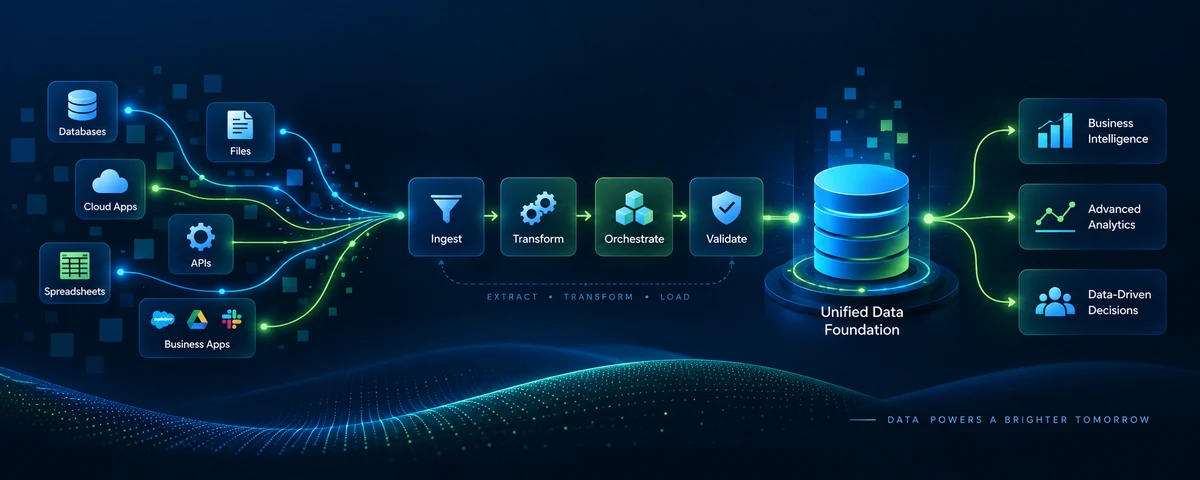
Most businesses don’t wake up one day and decide they need data engineering services. It usually starts smaller than that — a report that takes someone half a day to put together by hand every week, three systems that all claim a different number for “total sales,” or a founder asking “can we just see this on one dashboard?” and nobody quite being able to answer yes. By the time a business actually goes looking for data engineering services, there’s usually already a specific, annoying problem behind the search. This guide covers what data engineering actually is, when it’s genuinely worth doing, and what to expect from a real project.
What Is Data Engineering, Really?
Data engineering is the work of getting data out of the places it’s scattered — a CRM, a payments processor, spreadsheets, an app database — and into a shape where it can actually be trusted and used, whether that’s a dashboard, a report, or an AI system that needs clean input to work well. It’s the plumbing, not the reporting itself. A data analyst or a dashboard tool gets the credit for the nice chart; a data engineer is the reason the numbers behind that chart are correct, current, and don’t silently break when someone renames a column upstream.
Google Cloud’s overview of data engineering is a reasonable technical starting point if you want the fuller picture of the tools and roles involved.
Data Engineering Services: What They Actually Cover
When people say “data engineering services,” they usually mean some combination of four things, and a good provider should be able to name which of these your project actually needs rather than selling all four by default:
- Data pipelines — the automated process that moves data from source systems into a place it can be used, on a schedule or in real time.
- Data warehousing — a central place (like BigQuery, Snowflake, or a well-structured database) where cleaned data actually lives, instead of staying scattered across ten tools.
- Data quality and validation — the unglamorous but essential checks that catch a broken number before it reaches a dashboard, not after someone’s already made a decision based on it.
- Integration work — connecting systems that were never designed to talk to each other, so information doesn’t have to be copied by hand between them.
A small business asking for data engineering services often just needs the first two; a larger operation juggling a dozen tools usually needs all four working together.
The Problems That Usually Trigger a Project Like This
A few patterns come up again and again in early conversations with businesses considering data engineering services:
- The “which number is right” problem — sales looks different in the CRM, the accounting tool, and the spreadsheet someone maintains by hand, and nobody fully trusts any of them anymore.
- The manual-export treadmill — someone spends real hours every week exporting CSVs from one system and pasting them into another just to build a report.
- The “we have the data but can’t use it” problem — years of data sitting in a system, but nobody can actually query it in a way that answers a real business question.
- Getting ready for AI or automation — an AI agent or automation is only as good as the data it can reach, and messy or scattered data is usually the real blocker, not the AI part itself.
If none of these sound familiar, there’s a decent chance full data engineering services aren’t what’s actually needed yet — see the honest tradeoffs section below.
What a Real Data Pipeline Looks Like, Step by Step
Stripped of jargon, a pipeline does four things in order: it extracts data from the source (an API, a database, an export), transforms it into a consistent, clean shape (fixing formats, removing duplicates, matching records across systems), loads it somewhere usable, and then runs on a schedule so it stays current without someone doing it by hand. The transform step is where most of the real engineering effort goes — source systems are rarely clean, and quietly handling the edge cases (a missing field, a currency mismatch, a record that shows up twice) is what separates a pipeline that works for a month from one that keeps working for years.
The Honest Tradeoffs Nobody Mentions
Not every business needs data engineering services yet, and it’s worth saying that plainly rather than upselling them anyway. If your data lives in one or two tools and a well-built spreadsheet or a native export already answers your questions, building a full pipeline is often solving a problem you don’t have — that budget is usually better spent elsewhere until the manual-export treadmill actually starts hurting.
Where a project is genuinely justified, a few real costs are worth planning for upfront: pipelines need monitoring, since a silent failure means a dashboard quietly goes stale without anyone noticing right away; source systems change over time (a field gets renamed, an API gets deprecated), so a pipeline isn’t a one-time build, it needs occasional maintenance; and the first version is rarely the final one — expect to revise the transform logic once real users start asking harder questions of the data. Anyone who tells you a data pipeline is “set up once and forget it” hasn’t maintained one for long.
Choosing a Data Engineering Company
A few questions tend to separate a real data engineering company from one that will hand you an over-engineered solution for a simple problem:
- Do they ask what business question you’re actually trying to answer before proposing a technical solution, or do they jump straight to naming tools?
- Will they tell you honestly if your current problem doesn’t need a full pipeline yet?
- Do they design for your actual data volume and team size, or default to enterprise-scale tooling regardless of whether you need it?
- What does ongoing support look like once the pipeline is live — source systems change, and someone needs to be watching for it?
Where Inverosoft fits in
We work across web design and development, data engineering, machine learning, and custom AI agents — so when we build a pipeline, we’re usually also familiar with the systems generating the data in the first place (your website, your app, your existing tools), not just the data layer in isolation. If you’re weighing whether data engineering solutions make sense for your business right now, read more about our team or get in touch to talk through what you’re actually trying to solve.
Frequently Asked Questions
How is data engineering different from data analytics?
Data engineering builds and maintains the pipelines and infrastructure that get clean, reliable data into one place. Data analytics is what happens after that — asking questions of the data and turning it into charts, reports, or decisions. You genuinely need the first to trust the second.
Do we need a data warehouse, or can our existing database work?
Often an existing database is fine to start, especially for a smaller data volume — a dedicated warehouse (like BigQuery or Snowflake) becomes worth the switch once you’re combining data from several sources or the reporting queries start slowing down your main application database.
How long does a typical project take?
For data engineering services, a single, well-scoped pipeline connecting one or two sources can be live in a few weeks. Projects that touch many systems, need heavy data-quality work, or require ongoing historical backfill realistically take longer — the number of source systems matters more than the destination technology.
Is this only useful for large companies?
No — the problems that trigger this kind of project (the “which number is right” issue, the manual-export treadmill) show up just as often at a smaller scale, just with fewer systems involved. The fix is usually smaller and cheaper too; it scales down, not just up.
Good data engineering services are easy to over-sell and just as easy to dismiss as something only “big tech” needs — neither is quite true. The real question isn’t company size, it’s whether your team is still spending real hours reconciling numbers by hand. If that sounds familiar, reach out and we’ll tell you honestly whether a full pipeline is the right next step or whether something smaller would do the job.
